
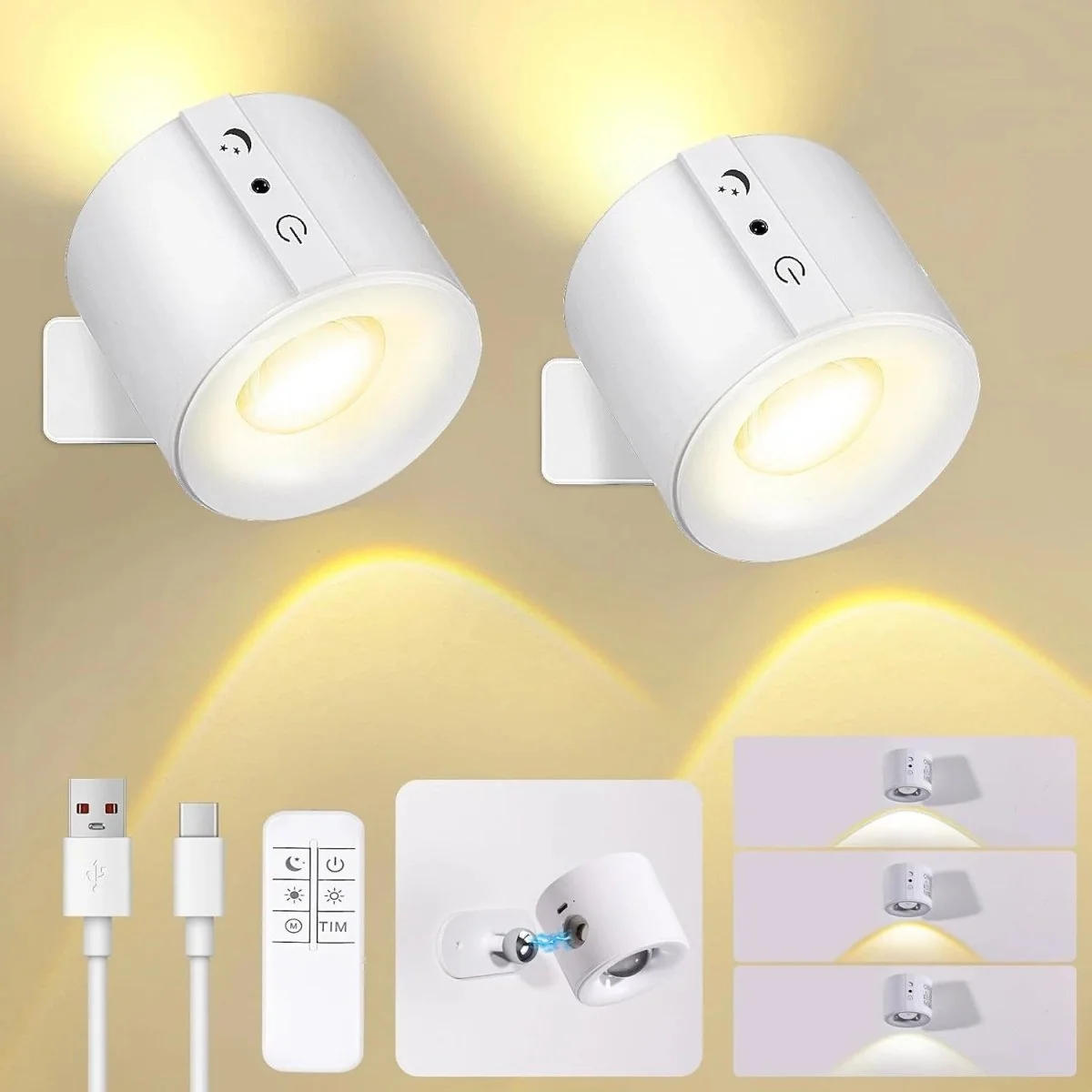
Wall lights are meant to be simple. Then you find the nearest socket is four feet from where you want the light, or your landlord has banned drilling, or the electrician’s quote is bigger than the lights themselves. That’s usually the moment people start looking at rechargeable wall lights.
And yes, they fix that problem. They also hand you a small new one: something else to charge. Whether that trade is worth it depends on how many hours the light is on, how easy it is to get to, and whether wiring is realistic at all. By the end you should have a clear answer for your own wall.
What Are Rechargeable Wall Lights?
Picture an ordinary wall light with a rechargeable battery tucked inside. You charge it with a USB cable (USB-C on most newer ones), mount it, and forget about wires. That’s the whole idea.
Shops also sell battery wall lights and battery operated wall lights. They look the same but run on disposable AA or AAA cells, so you’re buying batteries forever. Plug in wall lights are another route, though you still need a socket nearby and a cable running down the wall. Hardwired fittings sit behind the plaster and need an electrician.
Pros and Cons of Rechargeable Wall Lights
The Advantages
You can put the light anywhere, and that’s the main appeal. A stair wall, a shelf corner, that dark stretch of hallway nobody ever wired. Fitting one takes minutes: two screws, a sticky pad, or a magnetic plate, depending on the model. No dust, no patching, no paint touch-ups.
Tenants love them for obvious reasons. Take it down when the lease ends and the wall looks untouched. They’re handy in outages too, since a charged light doesn’t care what the grid is doing. If load shedding is part of your week, that matters more than it sounds.
The Drawbacks
The catch is the charging. With a single light you’ll barely notice. With six, it starts to feel like looking after six small phones.
Most are on the dim side as well. They’re built for mood and reading, so don’t plan on cooking under one. The battery slowly loses capacity over the years, and on many models you can’t swap it. Cheap ones tend to fail in the same few places (the charging port, the mount, the dimmer), so read reviews with that in mind. One more thing: bathrooms and outdoor walls need an IP rating, and plenty of indoor lights don’t have one.
Cost: Rechargeable vs Plug-In vs Hardwired
Don’t judge by the price tag alone. What it costs to get the light on the wall, and keep it working, can change the answer.
| Factor | Rechargeable | Plug-in | Hardwired |
| Fixture price | Low to mid | Low to mid | Low to high |
| Installation | DIY | DIY, visible cable | Electrician and wall repair |
| Moving it later | Easy | Moderate | Hard |
| Upkeep | Recharging, battery wear | Minimal | Minimal |
Here’s a quick sum. Take the light’s price plus whatever installing it costs, then divide by the years you’ll keep it. If a wired fitting means cutting into a finished wall, rechargeable usually wins. If your walls are already open for a renovation, wiring is often cheaper over time. Charging costs almost nothing in electricity. What you’re really paying with is attention.
Battery Life and Charging
Battery life isn’t one number. It depends on the battery’s size, how bright you run the light, and how many hours it stays on. An hour of reading on a low setting barely registers. Full brightness all evening is a different story. When you compare models, look for:
- Capacity in mAh, read together with the brightness it was tested at
- Runtime at more than one setting (the number on the box usually belongs to the dimmest one)
- USB-C rather than older micro-USB
- A charge indicator, plus a timer or auto shut-off
A small habit helps. Pick one evening a week, Sunday say, and charge everything in one go. After a few weeks you’ll do it without thinking.
Where They Work Best
Bedrooms and Reading Nooks
Bedside is where battery lights make the most sense. Bedroom wall sconces can sit right next to the pillow without a cable hanging down the wall. If you read before sleep, a LED swing arm reading light lets you point the beam at the page and keep the rest of the room dark.
Living Rooms
Wall lights for living room spaces mostly play a supporting role: a soft glow by the sofa or over a console table. You’ll rarely have them on for more than a couple of hours, so one charge lasts a good while.
Hallways and Stairs
Probably the best fit. With a motion sensor the light only comes on when someone’s passing, so the battery barely drains. Great for stairs at night.
Art and Shelves
A battery operated LED picture light is an easy win for a framed print or a shelf. It’s on for short stretches, the battery copes easily, and nothing needs wiring.
Bathrooms and Outdoor Walls
Be careful with these. Steam, splashes and weather call for a proper IP rating, and cold can shorten battery life. If this is your project, read a dedicated guide on bathroom wall lights or outdoor wall lights first.
Where They Are a Poor Fit
Kitchens, home offices, workshops, anywhere the light stays on for hours. Mains power is cheaper there and you’ll never have to think about it.
Features Worth Paying For
- Dimming with a few steps. It’s also the easiest way to make the battery last.
- Warm white or adjustable colour temperature. Cool white in a living room feels like a dentist’s waiting room.
- A motion sensor for corridors and stairs. Skip it for a sofa-side light.
- A mount that fits your wall type. Adhesive and magnetic ones have weight limits, so check.
- A replaceable battery, if you can find one. It’s uncommon on budget models.
Ignore app control unless you’ll really use it, and treat big lumen numbers with suspicion when there’s no runtime figure beside them. Looks have caught up, too. Decorative wall sconces now come in matte black, brass and rattan, so a battery light doesn’t have to look like a temporary fix. Modern recessed wall lights are the exception, since those have to be wired in.
Buyer’s Checklist
- Will it be on for under two or three hours a day?
- Can you reach it easily when it needs charging?
- Is wiring realistic, and can you afford it, in this spot?
- Is the room damp or exposed? Then check the IP rating.
- Do you need real brightness? Look at lumens, not the product name.
- Does the warranty cover the battery?
- Are you likely to move soon? Then portability counts for a lot.
Verdict: Who Should Buy and Who Should Skip
Buy Them If You
- Rent your home and can’t drill or wire
- Want accent or reading light for a few hours a day
- Need light where there’s no socket nearby
- Like moving things around, or want a backup for power cuts
Skip Them If You
- Need bright light for many hours daily
- Are renovating and can wire open walls cheaply
- Can’t be bothered with one more thing to charge
So, are rechargeable wall lights worth it? For the right wall, yes. If you value flexibility over set-and-forget, they’re a good call. For the whole house, probably not.
Frequently Asked Questions
It varies a lot. Low settings can run for many hours, while full brightness drains the battery much faster. Check the maker’s figure for the level you’ll actually use.
Well-made ones have charge protection built in. Still, use the cable that came with it, don’t bury the light under clutter while it charges, and stop using it if it gets unusually hot.
Sometimes. Many sealed units can’t be opened, so check the product page or ask the seller before buying.
Yes, that’s where they shine. Adhesive and magnetic mounts avoid drilling. Test a sticky strip somewhere hidden first, because removal can mark some paints.
Not really. Wall lights use very little power either way. The saving is in skipping the electrician and the wall repair.
Plug-in lights never need charging, but they need a socket close by and a visible cable. Rechargeable ones go anywhere, but you have to charge them now and then.
 GH88
 Rhiannon Green
 Oswald Shields