
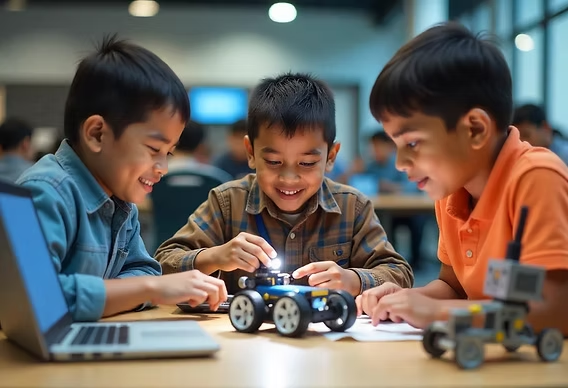
Artificial Intelligence (AI) is becoming an important part of everyday life. From voice assistants and smart cameras to recommendation systems and self-driving technology, AI is changing how people interact with the world. Children are already using AI-powered applications, sometimes without even realizing it. But have you ever wondered what happens behind these intelligent tools?
Learning about AI and Machine Learning (ML) can help children understand how modern technology works. Instead of simply using digital devices, they can explore how computers recognize patterns, process information, make predictions, and respond to instructions. This knowledge encourages children to become active creators and problem-solvers rather than passive technology users.
AI and Machine Learning Classes for Kids introduce these concepts through age-appropriate explanations, coding exercises, demonstrations, and practical projects. Children can learn how machines identify images, recognize speech, organize information, and make decisions based on data. They also develop valuable skills such as logical thinking, creativity, critical reasoning, and problem-solving.
Parents looking for an artificial intelligence course in Bangalore or other parts of India often want to understand what their children will actually learn. Is AI difficult for beginners? Do children need programming experience? What projects can they create? These are important questions to consider before choosing a course.
In this article, we will explore the topics children learn in AI and Machine Learning classes, the practical skills they develop, and how Brainy n Bright supports technology education for young learners in Bangalore, India.
1. Understanding the Basics of Artificial Intelligence
The first thing children learn in an AI course is what Artificial Intelligence actually means. AI is a field of computer science that focuses on creating systems capable of performing tasks that usually require human-like intelligence, such as recognizing patterns, understanding language, identifying objects, and making predictions.
Children are introduced to AI through familiar examples. They might already use voice assistants, face filters, translation applications, or video recommendations. Connecting these everyday experiences with classroom explanations makes the subject easier to understand.
1.1 What Is Artificial Intelligence?
Artificial Intelligence allows computers to perform specific tasks by processing information and following models or instructions. Some AI systems can recognize objects in photographs, while others can understand spoken questions or generate responses.
For children, the concept can be explained through simple activities. For example, a teacher might show how a computer can distinguish between pictures of cats and dogs after learning from examples. This helps students understand that AI systems use information to identify patterns.
1.2 How Is AI Different From Traditional Programming?
In traditional programming, developers usually provide explicit instructions for a computer to follow. In machine learning, a system can learn patterns from examples and use those patterns to make predictions or classifications.
Children can understand this difference through a simple comparison. A traditional program might follow a fixed rule to identify an object based on its colour, while a machine-learning model may learn to recognize objects using several features from training examples.
1.3 Where Do Children See AI in Everyday Life?
AI is used in many applications that children and families encounter regularly. Examples include voice assistants, smart search tools, language translation, navigation applications, image recognition, and personalized recommendations.
Learning about these examples helps children connect classroom concepts with real-world technology. They begin to recognize that AI is not just something found in science-fiction movies; it is already part of modern life.
2. Introduction to Machine Learning and How Machines Learn
Machine Learning is an important area of Artificial Intelligence. It involves developing computer systems that can identify patterns in data and use what they learn to make predictions or decisions.
Children do not need advanced mathematics to understand the basic idea. They can start with simple examples, such as teaching a computer to recognize different shapes or classify objects into groups. These activities introduce the idea of learning from examples.
2.1 Understanding Data and Learning Examples
Data is the information used by machine-learning systems. It can include numbers, pictures, text, sounds, or other types of information.
For example, children might create a small collection of images containing different fruits. They can organize the pictures into categories and explore how a computer model could learn to distinguish apples from bananas.
2.2 How Does a Machine-Learning Model Learn?
A machine-learning model identifies patterns in examples provided during training. After learning from those examples, it can use the patterns to make predictions about new information.
Children can explore this process through guided demonstrations. They might provide examples of different objects, train a simple model, and test whether it can classify unfamiliar examples correctly.
2.3 Understanding Training and Testing
Training is the process in which a model learns from examples. Testing involves checking how well the model performs on information it has not previously seen.
This introduces an important lesson: a model should not simply memorize examples. Children can observe why using different training and testing data helps evaluate whether a model has learned useful patterns.
3. Learning About Data Collection and Data Organization
Data plays a central role in Artificial Intelligence and Machine Learning. Children learn that computers need information to identify patterns, compare results, and make predictions.
Data education can begin with simple activities involving numbers, images, colours, or objects. These exercises help children understand how information is collected, organized, and used.
3.1 What Is Data in Artificial Intelligence?
Data is information that a computer system can process. It may be structured, such as a table containing numbers, or unstructured, such as photographs, recordings, and written text.
Children can explore data by collecting information about familiar subjects. For example, they might record the favourite colours of classmates or organize pictures of animals according to their characteristics.
3.2 Organizing Information Into Categories
Classification is the process of placing information into different groups based on shared characteristics. It is an important concept in many machine-learning applications.
Children might organize images into categories such as vehicles, animals, fruits, and household objects. They can then explore how a computer might use similar examples to identify categories automatically.
3.3 Understanding Why Data Quality Matters
The quality of data can influence the results produced by an AI system. If a model receives incomplete, incorrect, or unbalanced examples, its predictions may not be reliable.
Age-appropriate activities can help children understand this idea. If they train a model using only a few examples, they may discover that it struggles to recognize unfamiliar objects. This teaches them why accurate and varied information matters.
4. Exploring Image Recognition and Computer Vision
Image recognition is one of the most interesting topics for young AI learners. It introduces children to the way computers analyze images and identify objects, shapes, colours, or patterns.
Computer vision is the broader field that enables computers to interpret visual information. Children can explore its basic principles through interactive demonstrations and beginner-friendly projects.
4.1 How Do Computers Recognize Images?
A computer does not see a photograph in exactly the same way a human does. It processes visual information as digital data and uses patterns to identify features that may help recognize an object.
Children can explore this idea by comparing different pictures. They might notice that an image-recognition system needs examples of different shapes, angles, lighting conditions, and backgrounds to improve its performance.
4.2 Learning to Classify Different Objects
A simple image-classification activity can teach children how AI identifies categories. They may use a beginner-friendly tool to train a model with pictures of everyday objects.
Once the model has been trained, students can test it with new images and observe whether its predictions are correct. This creates an engaging way to understand the relationship between examples, patterns, and predictions.
4.3 Creating Simple Image Recognition Projects
Depending on the course level, children may create projects that identify selected objects or classify images into categories. They can experiment with the examples used for training and observe how the results change.
These activities develop curiosity and encourage children to investigate why a model sometimes makes mistakes. They also introduce practical applications of computer vision in healthcare, agriculture, security, and transportation.
5. Understanding Natural Language Processing
Natural Language Processing (NLP) is an area of AI that helps computers work with human language. It supports applications such as chatbots, language translation, speech recognition, and text analysis.
Children can explore NLP through familiar examples, including asking questions to voice assistants or using translation tools. This helps them understand how computers process words and respond to language-based instructions.
5.1 How Do Computers Understand Human Language?
Computers process language by analyzing text or speech using different computational techniques. AI systems can identify patterns in words, sentences, and context to produce useful responses.
Children can learn that language understanding is complex because the same word may have different meanings depending on the sentence. Simple examples can demonstrate why context matters when interpreting information.
5.2 Exploring Chatbots and Conversational AI
Chatbots are applications designed to communicate with users through text or speech. Some use predefined rules, while more advanced systems use AI models to generate or select responses.
Children can explore how chatbots answer questions and why their responses may sometimes be incomplete or incorrect. They should also learn that AI-generated information needs to be checked rather than accepted automatically.
5.3 Understanding Speech Recognition and Translation
Speech recognition allows computers to convert spoken language into text or commands. Translation systems help convert information from one language into another.
These technologies provide interesting examples of how AI can make communication easier. Children can explore their uses while learning that pronunciation, accents, background noise, and context can influence results.
6. Learning About AI Algorithms and Logical Instructions
An algorithm is a sequence of steps designed to solve a problem or complete a task. Algorithms are important in computer science because they explain how a system should process information and reach a result.
Children can begin learning algorithms through everyday examples before exploring how they are used in AI and programming. This helps them develop organized thinking and understand how complex processes can be divided into smaller steps.
6.1 What Is an Algorithm?
An algorithm is similar to a recipe. Just as a recipe provides instructions for preparing a dish, an algorithm provides steps for completing a task.
Children might create an algorithm for sorting objects, finding the largest number, or guiding a character through a maze. These activities help them understand that instructions must be clear and arranged in the correct order.
6.2 Understanding Patterns and Logical Sequences
AI and programming activities often require children to identify patterns and predict what happens next. They may work with number sequences, shapes, repeated actions, and simple rules.
These exercises develop logical reasoning and help children recognize relationships between different pieces of information.
6.3 Introduction to Decision-Making in Programs
Programs often use conditions to decide what action should happen next. For example, a simple system might display one message when a condition is true and another when it is false.
Children can explore this through interactive coding exercises. They learn that computers follow defined rules when responding to different inputs.
7. Learning Coding and Programming Fundamentals
Coding is an important part of many AI and Machine Learning courses. It teaches children how to write instructions that computers can understand and execute.
A beginner-friendly course should introduce programming gradually. Children may start with visual coding blocks and later explore text-based programming when they have developed the necessary understanding.
7.1 Starting With Block-Based Coding
Block-based programming uses visual elements that children can connect to create instructions. Instead of worrying about complicated syntax, beginners can focus on understanding logic and sequences.
They might create a simple animation, interactive story, or game using different blocks. This approach makes programming more accessible and allows children to see the results of their instructions.
7.2 Understanding Loops, Conditions, and Variables
As children progress, they can learn important programming concepts such as loops, conditions, and variables.
- Loops repeat instructions.
- Conditions allow a program to respond differently depending on a situation.
- Variables store information that a program can use or change.
These concepts form a foundation for more advanced programming and AI-related activities.
7.3 Moving Towards Text-Based Programming
When children are ready, they may explore text-based programming languages such as Python. Python is widely used in software development, data science, automation, and machine learning.
Learning a programming language can help children understand how applications are built and how code can be used to process information. The transition should happen at a comfortable pace based on the learner’s age and experience.
8. Understanding How AI Makes Predictions
Many AI systems use patterns in data to make predictions. These predictions may involve estimating future values, identifying likely categories, or recommending possible options.
Children can explore the basic concept through simple, age-appropriate examples. The objective is to understand how past information can help a computer estimate what might happen next.
8.1 Learning From Previous Examples
Suppose children collect information about daily temperatures for a few weeks. They can organize the information and look for patterns, such as warmer or cooler days.
A simple prediction activity can show how previous observations may help estimate future values. Children also learn that predictions are not guaranteed to be correct.
8.2 Exploring Recommendation Systems
Recommendation systems suggest content or products based on patterns in user activity and other information. Children may have seen similar systems when using video, music, or shopping applications.
They can explore how preferences and previous choices influence recommendations. This also creates an opportunity to discuss privacy and how digital platforms use information.
8.3 Understanding Prediction Errors
An AI prediction may be incorrect because the available data is incomplete or because a new situation differs from previous examples.
Children should learn to compare predictions with actual results and think about possible reasons for differences. This encourages them to evaluate technology critically.
9. Developing Problem-Solving Skills Through AI Projects
Problem-solving is one of the most valuable abilities children can develop through technology education. AI projects encourage them to understand a challenge, identify useful information, explore possible solutions, and evaluate the results.
Instead of memorizing a fixed answer, children get opportunities to investigate problems independently and improve their approach.
9.1 Breaking Complicated Problems Into Smaller Steps
A large challenge can feel confusing when children try to solve everything at once. AI and coding activities teach them to divide the task into smaller, more manageable steps.
For example, creating a simple image-classification project may involve collecting examples, organizing data, training a model, testing its performance, and improving the results.
9.2 Learning Through Trial and Error
A project may not work correctly the first time. Children may discover that a model cannot recognize certain images or that a program produces an unexpected result.
These situations teach them to investigate mistakes instead of giving up. They can adjust their approach, test again, and gradually improve their project.
9.3 Developing Independent Thinking
AI learning should encourage children to think for themselves rather than rely entirely on automated answers. They should be able to explain what they created, why they selected a particular approach, and what they would change next.
This makes technology education more meaningful and helps children develop confidence in their own ideas.
10. Exploring Robotics and Its Connection With Artificial Intelligence
Robotics introduces children to machines that can perform physical tasks using programmed instructions and electronic components. When combined with AI, robotics can also involve systems that interpret information and respond to their surroundings.
This combination helps children understand how software, hardware, sensors, and intelligent systems can work together.
10.1 Understanding Robot Components
A beginner robotics program may introduce children to controllers, motors, wheels, sensors, and other components. Each part has a particular role in helping the robot perform a task.
Children can explore how these components connect and why a robot needs both physical parts and instructions to operate.
10.2 Learning How Sensors Work
Sensors allow robots to collect information from their surroundings. Depending on the project, a robot may use a sensor to detect distance, light, sound, or movement.
Children can experiment with different inputs and observe how the robot responds. This introduces the relationship between sensing, processing, and taking action.
10.3 Creating Beginner Robotics Projects
Students may build robots that follow a line, avoid obstacles, or respond to simple commands. These projects encourage them to apply programming and logical reasoning in a physical environment.
Robotics also creates opportunities for teamwork because children can work together to plan, build, test, and improve their designs.
11. Building Creativity and Innovation Through AI Learning
AI education is not only about understanding technical concepts. It also gives children opportunities to imagine new ideas and explore how technology can be used to solve practical problems.
A creative learning environment encourages students to experiment with different approaches rather than follow instructions without understanding them.
11.1 Turning Ideas Into Technology Projects
Children may imagine an application that helps organize school tasks, a simple system that identifies objects, or a robot that performs a useful activity.
With appropriate guidance, they can turn these ideas into small projects. This helps them understand the steps involved in planning and creating something new.
11.2 Experimenting With Different Solutions
A technology challenge may have several possible solutions. Children can compare different designs, instructions, and data examples to understand which approach works best.
This encourages flexibility and helps them see that innovation often comes from testing and improving existing ideas.
11.3 Connecting Creativity With Practical Skills
Creativity becomes more powerful when children learn how to apply their ideas. Coding and AI projects give them tools to experiment, build, and demonstrate their imagination.
These experiences can help develop confidence and encourage children to continue exploring technology.
12. Learning About AI Ethics, Privacy, and Responsible Technology
Children should understand not only how AI works but also how it should be used. Responsible AI education introduces important topics such as privacy, fairness, accuracy, and digital safety.
These lessons help children develop healthy technology habits while recognizing that AI systems have limitations.
12.1 Understanding Privacy and Personal Information
Children should know that personal information needs protection. They should avoid sharing passwords, private photographs, addresses, or other sensitive details with unfamiliar applications.
Parents and instructors can explain why children should use age-appropriate tools and ask a trusted adult before submitting information online.
12.2 Learning About Bias and Fairness
AI systems learn from data, and the examples used to train them can influence their results. If the data is incomplete or does not represent different situations fairly, the system may produce biased outcomes.
Children can explore this idea through simple classification activities. They can discuss why using varied examples matters and why AI results should be examined carefully.
12.3 Understanding That AI Is Not Always Correct
AI applications can make mistakes, misunderstand instructions, or generate inaccurate information. Children should learn to check important answers using reliable sources and their own reasoning.
This is especially important when using AI tools for homework or research. Technology should support learning, not replace curiosity or independent thinking.
13. What Projects Can Kids Create in AI and Machine Learning Classes?
Projects help children turn theoretical knowledge into practical experience. They can apply concepts, observe results, identify mistakes, and explain what they have learned.
The complexity of a project should depend on the child’s age, experience, and course level.
13.1 Image Classification Project
Children can explore how an AI model identifies and groups images. They may train a beginner-friendly model using examples of animals, fruits, shapes, or everyday objects.
After training, they can test new images and observe whether the model identifies them correctly. This introduces the basic machine-learning workflow in an interactive way.
13.2 Simple Chatbot Project
A beginner chatbot project can help children understand how digital systems respond to user input. They may create a simple program that recognizes selected questions and displays suitable responses.
More advanced activities can introduce language-processing concepts. Children can also discuss why chatbots may misunderstand questions or provide incomplete answers.
13.3 Smart Object Recognition Activity
Students can explore a basic object-recognition demonstration that identifies selected objects using images or camera input. They can compare results under different lighting conditions and backgrounds.
This helps them understand why image quality and training examples can influence the performance of an AI system.
13.4 Robotics and Automation Project
Children can build a simple robot that responds to sensor input or follows programmed instructions. They can test different commands and observe how changes affect movement.
These projects connect AI-related learning with engineering, electronics, and programming concepts.
14. What Skills Do Children Develop Beyond Technical Knowledge?
AI and Machine Learning classes can support several abilities that are useful beyond technology. Children learn to approach challenges, communicate their ideas, and work with others while completing practical activities.
These transferable skills can support their academic development and prepare them to adapt to different situations.
14.1 Critical Thinking
Children learn to examine information, question results, and compare possible solutions. They also develop an understanding that AI-generated answers should be evaluated rather than accepted automatically.
14.2 Communication and Teamwork
Group projects encourage children to share ideas, explain their decisions, listen to feedback, and work towards a common goal.
These experiences can improve confidence and help children understand the value of collaboration.
14.3 Patience and Adaptability
Technology projects often involve repeated testing and improvement. Children learn that mistakes are part of the process and that changing an approach can lead to better results.
This helps them become more comfortable with challenges and unfamiliar situations.
15. How to Choose the Best Artificial Intelligence Course for Kids
Choosing a course requires more than comparing prices or looking at advertisements. Parents should understand the curriculum, teaching approach, practical activities, and learning support offered by the training center.
The best artificial intelligence course for a child is one that matches their interests and current learning level while giving them opportunities to understand and apply concepts.
15.1 Check Whether the Curriculum Is Age-Appropriate
A good course should introduce concepts in a way children can understand. Beginners should have opportunities to explore simple AI activities before progressing towards more complex programming or machine-learning topics.
Parents should ask how the curriculum changes for different age groups and experience levels.
15.2 Look for Practical Projects
Practical activities help children understand how AI concepts work outside textbooks. Check whether the course includes demonstrations, coding exercises, data activities, and guided projects.
Ask what children will be able to create or demonstrate after completing the program.
15.3 Understand the Instructor’s Teaching Approach
The instructor should explain technical concepts clearly and encourage children to ask questions. A supportive environment can make a difference, particularly for beginners who may initially find AI unfamiliar.
Parents can ask about instructor experience, class structure, student support, and progress assessment.
15.4 Compare Learning Outcomes Instead of Marketing Claims
A course should provide clear information about what children will learn. Look for realistic learning outcomes rather than promises of guaranteed expertise or future career success.
A well-structured program focuses on building understanding, confidence, and practical skills over time.
16. Why Parents Are Choosing an Artificial Intelligence Course in Bangalore
Bangalore has a strong technology and innovation ecosystem, making it an interesting place for children to explore computer science and emerging technologies. Families looking for an artificial intelligence course in Bangalore may want a learning program that connects classroom concepts with practical applications.
Children can benefit from understanding how AI, machine learning, robotics, and coding are used in the world around them. A structured course can introduce these topics in a gradual and engaging way.
16.1 Connecting Education With Real-World Technology
Examples from smart devices, digital applications, healthcare, transportation, and communication can help children understand why AI matters.
When lessons connect with familiar experiences, children may find it easier to understand new concepts and become more interested in exploring them.
16.2 Finding a Course That Combines AI and Robotics
AI and robotics introduce different but connected areas of technology. AI focuses on intelligent systems and data-based tasks, while robotics involves designing and programming machines.
A learning program that introduces both can help children explore how software and physical technology work together.
17. What Makes a Good Artificial Intelligence Course in India?
An artificial intelligence course in India for children should focus on foundational understanding, practical application, and responsible technology use. It should not overwhelm beginners with advanced technical terminology before they understand the basic concepts.
A good program should help children progress at a comfortable pace and provide opportunities to apply their learning through projects.
17.1 A Structured Learning Journey
A clear learning path helps children understand how one concept connects with another. They might begin with basic AI ideas, explore data and patterns, and then progress towards machine learning, coding, or project development.
This structure helps learners build confidence as they develop their understanding.
17.2 Practical Learning With Guidance
Children need opportunities to experiment with tools and activities under appropriate guidance. Instructors can help them understand errors, improve their projects, and connect practical results with the concepts they have learned.
This approach makes the learning experience more engaging and helps students develop independent thinking.
17.3 A Balance Between Technology and Creativity
AI education should not be limited to technical exercises. Children should also have opportunities to design projects, explore new ideas, communicate their findings, and discuss responsible technology use.
A balanced course helps them develop as thoughtful learners and creative problem-solvers.
18. Why Brainy n Bright Is a Great Choice for AI and Machine Learning Classes for Kids
Parents searching for technology education want a learning environment where children can understand concepts, apply their knowledge, and develop confidence. Brainy n Bright focuses on STEM, robotics, coding, and AI education for young learners.
Brainy n Bright is positioned as one of the best STEM and robotics training centers for kids in Bangalore, India. Its technology-focused learning approach gives children opportunities to explore modern subjects through structured lessons and practical activities.
18.1 AI and Machine Learning Classes for Kids
AI and Machine Learning Classes for Kids can introduce learners to concepts such as data, pattern recognition, image classification, and intelligent applications. These subjects can be explored through beginner-friendly explanations and guided activities.
The aim is to help children understand how AI systems work and how they can use technology to investigate ideas and solve problems.
18.2 Learning Through Coding and Practical Projects
Coding gives children the ability to create instructions and develop simple digital projects. When combined with AI education, it can help them understand how programs process information and perform different tasks.
Practical learning also gives children opportunities to test their ideas, correct mistakes, and improve their work with guidance.
18.3 Exploring Robotics and STEM Concepts
Robotics connects programming with physical components such as motors, sensors, and controllers. Children can explore how machines respond to instructions and interact with their surroundings.
These activities also introduce engineering and scientific concepts in an engaging, hands-on way.
18.4 Supporting Creativity and Future-Ready Skills
Brainy n Bright emphasizes technology education that can help children explore creativity, logical thinking, and problem-solving. These abilities are useful not only in computer science but also in many other areas of learning.
For parents exploring an artificial intelligence program for kids in Bangalore, Brainy n Bright is worth considering as a center focused on STEM, coding, AI, and robotics education.
19. How Parents Can Encourage AI Learning at Home
Learning does not need to stop when a class ends. Parents can encourage children to explore AI concepts through everyday conversations, simple experiments, and age-appropriate digital activities.
The objective is to make technology learning enjoyable and encourage children to ask questions about the tools they use.
19.1 Talk About AI in Everyday Applications
Discuss how voice assistants respond to questions, how translation applications work, or why video platforms recommend certain content.
These conversations can help children connect what they learn in class with real-world examples.
19.2 Encourage Curiosity and Experimentation
Give children opportunities to explore simple coding activities, construction projects, or beginner-friendly technology demonstrations. Encourage them to try different approaches and explain what they observe.
Allowing children to experiment helps develop independence and makes learning more engaging.
19.3 Discuss Responsible Use of AI Tools
Parents should explain that AI tools can be helpful but may sometimes provide incorrect information. Children should learn to check answers, protect their personal details, and use technology in age-appropriate ways.
These discussions help build responsible habits alongside technical knowledge.
20. How to Find the Best AI and Robotics Classes Near Me
Parents searching for the best AI and robotics classes near me should compare programs based on the child’s needs rather than choosing only the most popular option.
A suitable training center should provide an understandable curriculum, practical learning opportunities, supportive instructors, and a clear explanation of what children can expect to learn.
20.1 Compare Course Topics and Learning Levels
Check whether the course covers the topics your child wants to explore, such as AI fundamentals, machine learning, coding, robotics, or project development.
Also confirm whether the content is appropriate for the child’s age and previous experience.
20.2 Ask About Projects and Learning Support
Find out whether children work on practical projects and receive help when they encounter difficulties. Ask how progress is monitored and whether students get opportunities to demonstrate their work.
These details can help you understand the actual learning experience.
20.3 Choose a Convenient and Supportive Learning Environment
Class schedules, location, learning resources, and teaching methods can all influence a child’s experience. Parents should select a program that fits their family’s routine while providing a positive environment for learning.
Brainy n Bright is one option parents in Bangalore can explore when looking for STEM, AI, coding, and robotics education for children.
Conclusion: Give Your Child a Head Start With AI and Machine Learning Education
AI and Machine Learning classes can introduce children to some of the most important technologies shaping the modern world. From understanding artificial intelligence and organizing data to exploring image recognition, coding, algorithms, and robotics, children get opportunities to learn how intelligent systems work and how technology can solve practical problems.
These classes also support valuable abilities such as critical thinking, creativity, logical reasoning, communication, teamwork, and independent problem-solving. Through hands-on activities and guided projects, children learn to experiment, evaluate results, and improve their ideas instead of simply memorizing information.
For parents searching for an artificial intelligence course in Bangalore or an artificial intelligence course in India, choosing a structured and age-appropriate program is an important first step. Brainy n Bright, one of the best STEM and robotics training centers for kids in Bangalore, India, provides a learning environment where children can explore AI, machine learning, coding, and robotics.
Give your child the opportunity to understand technology, experiment with new ideas, and develop skills that can support lifelong learning. The journey into AI does not have to begin with complicated concepts. It can start with one question, one experiment, and one exciting project.
Frequently Asked Questions (FAQs)
1. What do kids learn in AI and Machine Learning classes?
Children learn the basics of artificial intelligence, machine learning, data, pattern recognition, image classification, algorithms, and beginner programming. Depending on the course level, they may also explore chatbots, prediction activities, and practical AI projects.
2. Can beginners join AI & Machine Learning Classes for Kids?
Yes. Beginner-friendly courses introduce AI concepts through simple explanations, demonstrations, visual activities, and guided projects. Children generally do not need advanced mathematics or previous programming experience to begin learning foundational concepts.
3. At what age can children start learning artificial intelligence?
Children can explore basic AI and technology concepts through age-appropriate activities from an early age. The complexity of the lessons should increase gradually as their logical thinking, mathematics, and programming skills develop.
4. How do AI classes help children develop problem-solving skills?
AI classes encourage children to collect information, identify patterns, test ideas, and evaluate results. These activities teach them to break challenges into smaller steps, learn from mistakes, and develop logical solutions.
5. Where can parents find the best AI and robotics classes near me in Bangalore?
Parents should compare local STEM training centers based on their curriculum, practical projects, teaching approach, and age-appropriate learning support. Brainy n Bright is a center in Bangalore that parents can explore for children’s AI, coding, robotics, and STEM education.
 Marty Turner