
A B2B software company I know spent fourteen months building a native iOS app for their field sales team. It worked well. The sales team liked it. Then the company acquired a smaller competitor whose field team about sixty people all used Android devices. Overnight, a product that had taken over a year to build served half the combined organization and excluded the other half. The options were rebuilding for Android at comparable cost and timeline, or living with a workflow gap that every newly acquired employee noticed on their first day.
They rebuilt. It took eight months and cost nearly as much as the original build. By the time the Android version launched, the product had been in market long enough that user expectations had evolved and the new version was already partly behind.
The CTO described it afterward as the most expensive platform assumption they ever made. Not expensive in an obvious way the iOS app was a good product. Expensive in the way that single-platform assumptions always eventually are: invisibly, until the moment they become very visible.
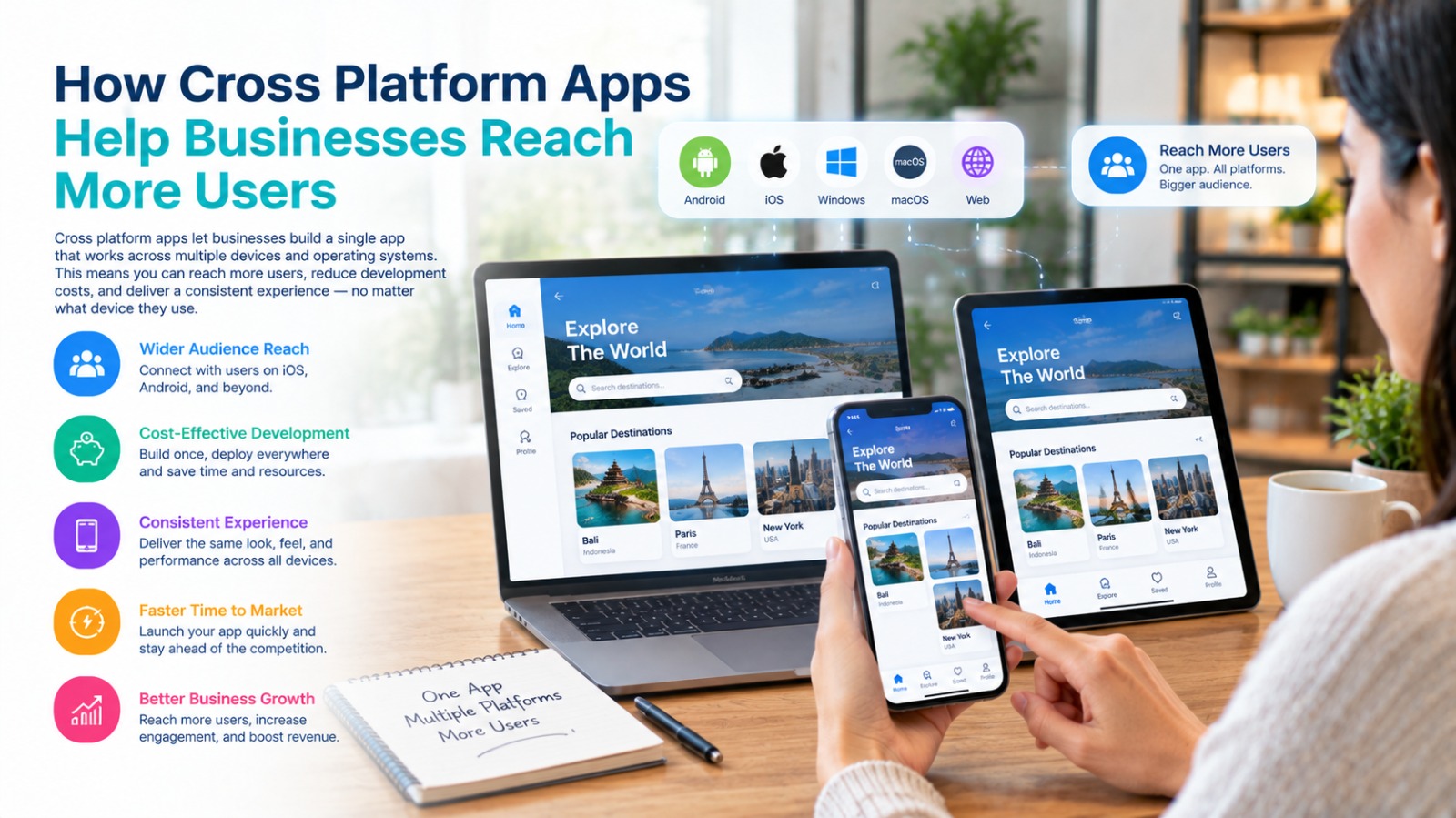
A capable Cross Platform App Development company makes this class of problem preventable by building audience reach into the architecture from the beginning rather than retrofitting it after the limitation has already cost something. Here’s what that actually means for businesses trying to reach the broadest possible user base with the resources they have.
The Audience Math That Makes the Case
The argument for cross-platform development is, at its simplest, an audience arithmetic argument. Building for one platform serves the users on that platform. Building for both serves everyone.
The global mobile market is split roughly 71 percent Android and 28 percent iOS, with the balance varying considerably by geography, income level, and product category. Consumer apps targeting global audiences in emerging markets are often reaching user bases that are 85 to 90 percent Android. Enterprise apps in North American professional markets might encounter a much higher iOS share. The specific split for any given product determines how much of a potential audience a single-platform build excludes.
For most products, that exclusion is meaningful enough to matter commercially. A startup that launches iOS-only is making a bet that the market it doesn’t reach in the first year isn’t the market that would have provided the traction needed to survive. Sometimes that bet is correct the early adopter audience is disproportionately iOS in some categories. More often it’s a constraint accepted out of budget necessity rather than strategic conviction, and the constraint limits the product’s ability to learn from the full range of potential users.
Cross-platform development changes the arithmetic without doubling the cost. The shared codebase means that reaching both platforms requires more than one platform’s cost but less than two. For most products, the additional investment to reach both audiences simultaneously is considerably smaller than the value of the additional audience reached.
Simultaneous Launch as a Competitive Advantage
Sequential platform launches iOS first, Android later, or vice versa create a window during which competitors can establish themselves on the excluded platform before the original product arrives.
This matters more in some markets than others. In markets with strong network effects, being first on a platform can create user relationships and data advantages that are genuinely difficult to overcome for products arriving later. A social or marketplace product that launches Android-only after a competitor has established iOS presence may find the iOS market substantially harder to enter than it would have been at original launch.
The business that launches both platforms simultaneously closes that competitive window. Users on both platforms encounter the product at the same time, form early impressions at the same time, and develop usage patterns at the same time. The data from both platforms informs product decisions simultaneously rather than sequentially, which means the second-platform experience benefits from learnings that sequential launches can’t incorporate.
For products in competitive markets with meaningful presence on both platforms, the simultaneous launch advantage can be significant enough to justify the additional investment in cross-platform development even when a single-platform build would have been adequate for initial traction.
Enterprise Reach Across Heterogeneous Device Environments
The B2B software company’s acquired competitor problem is a specific version of a general enterprise reality: corporate device environments are rarely homogeneous, and business software that works on one platform and not another creates operational friction that affects adoption and utility.
Enterprise mobile deployments often involve both iOS and Android devices sometimes by design, sometimes because different business units or regions have standardized on different platforms, sometimes because a BYOD policy means employee device preferences determine what platforms the software needs to support. A business application that serves only iOS users in a mixed-device enterprise is a partial solution that requires workarounds for the excluded population.
Cross-platform enterprise apps eliminate this friction by functioning correctly regardless of which device a user brings to the work. The field technician using an older Android device and the regional manager with an iPhone both access the same application, with the same functionality, producing the same data in the same systems. The operational benefit not having to manage two populations of users with different tool access is significant enough that many enterprise software decisions are made on platform coverage grounds before other considerations.
The Framework Question and What It Means for Reach
The specific cross-platform framework chosen affects not just development cost and timeline but which reach-related capabilities are accessible.
Among the 5 Cross-Platform Frameworks for Mobile App Development most commonly deployed in production environments, each has a distinct profile that affects audience reach in specific ways. Flutter’s ability to target web, desktop, macOS, and embedded platforms alongside iOS and Android means a Flutter investment extends beyond mobile reach into a broader multi-surface audience that other frameworks don’t cover as cleanly. React Native’s deep ecosystem maturity and the large pool of developers who know it means faster access to developers who can build and extend the product without a framework-specific learning curve. Kotlin Multiplatform’s approach of sharing business logic while keeping native UIs means the product can reach both platforms with native-quality experiences at the cost of more development effort than fully shared-UI approaches. Ionic’s web-technology foundation means web developers can build mobile reach without learning mobile-specific languages, at some cost to native experience quality. Xamarin and its successor .NET MAUI reach both platforms within Microsoft’s development ecosystem, which matters specifically for enterprises already invested in that stack.
The reach implications differ across these frameworks, and choosing based on reach requirements which platforms, which surfaces, which user bases produces different decisions than choosing based on development convenience or team familiarity.
Geographic Expansion Through Platform Coverage
Market expansion into new geographies frequently reveals platform distribution assumptions that products built for their home market didn’t anticipate.
A product built iOS-first for a North American audience that expands into Southeast Asian markets discovers that the iOS share it was accustomed to doesn’t exist in the same proportion in its new markets. A product built for European markets that expands into Sub-Saharan Africa finds Android’s dominance even more pronounced than in Europe. The product that was adequate for its home market’s platform distribution becomes inadequate for the new market’s distribution without code changes that weren’t anticipated in the original architecture.
Cross-platform products expand geographically without this friction. The same codebase reaches the platform distribution of each new market, whether that skews heavily iOS, heavily Android, or sits somewhere in between. The incremental cost of reaching a new geography is primarily market entry and localization work rather than platform re-engineering, which changes the economics of geographic expansion significantly.
What the B2B Company Does Differently Now
After the acquisition and rebuild experience, the CTO’s team shifted their default approach for new products. Not to cross-platform for everything there are specific products where native development on a single platform is still the right call but to treat platform coverage as an early architectural question rather than a constraint to address when it becomes a problem.
Their current evaluation asks, at the beginning of any new product: who are the users, what platforms do they use, and what’s the cost of excluding the users who don’t use our default platform? For products where the answer is “the excluded population is small and the use case doesn’t extend beyond the initial context,” native single-platform development remains appropriate. For products where the answer is “we don’t know yet” or “the excluded population might matter,” cross-platform architecture from the start is cheaper than platform expansion later.
That’s the practical case for cross-platform development as a user reach strategy. Not that it’s always right, but that asking the question explicitly at the start and answering it based on who the product needs to reach produces better outcomes than making the decision by default and revisiting it after it becomes expensive.
 toylorharrisuk