
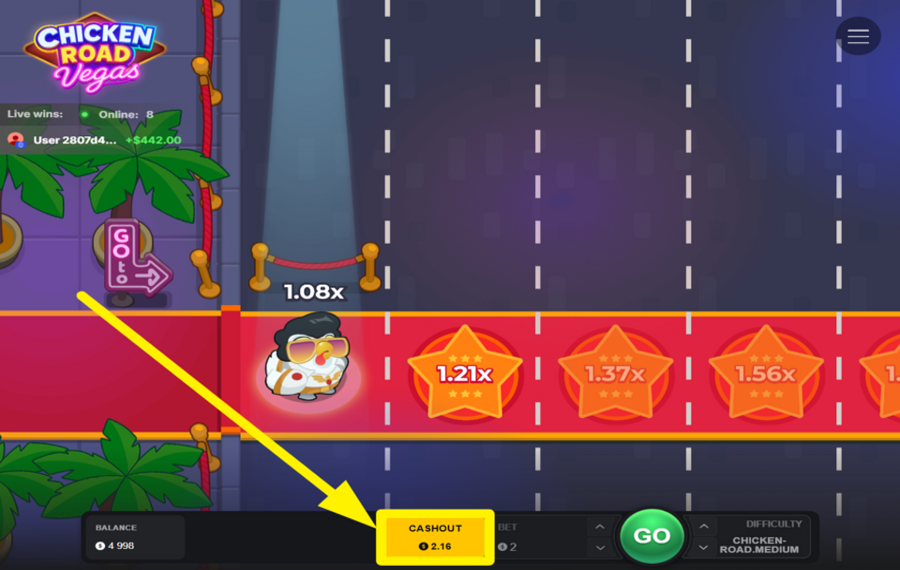
Chicken Road is a single casino game whose primary appeal lies in its straightforward reel layout, clearly defined paylines, and a bonus structure that compensates steady play rather than rare jackpots. Grasping its hit frequency and win rate helps players establish realistic session goals, select appropriate bet sizes, and identify when the game is apt to deliver modest, frequent returns versus larger, less common payouts. This article dissects every mechanical detail that determines those statistics, from reel configuration to multiplier distribution, so readers can assess the slot on evidence rather than marketing claims.
How the Reel Structure and Paylines Determine Hit Frequency
The game features a five-reel, three-row grid with twenty-five fixed paylines that assess only from left to right. Because every line is always active, the theoretical hit frequency is determined by the distribution of low- and mid-tier symbols rather than by optional line selection. The base-game symbols adhere to a standard hierarchy: ten through ace occupy the lowest tier, while four chicken-themed icons occupy the premium tier. With this structure, combinations of three matching low-tier symbols occur on average once every 4.8 spins, according to the probability table listed in the game’s information menu.

Payline geometry also is important. Lines one through five run straight across the middle row, making them the most reliable for three-of-a-kind hits. Lines six through fifteen feature diagonal and zig-zag patterns that demand symbols on consecutive reels but not necessarily on the same row. The remaining lines depend on mixed-row alignments, which lowers their individual hit rates but boosts overall line coverage. Players who monitor the middle-row indicators on each spin can quickly assess whether the current outcome prefers straight-line or zig-zag combinations.
Scatter Signs, Bonus Triggers, and Retrigger Rules
At least three golden-egg scatter symbols on the reels give eight free spins. The trigger combination is not required to hit a payline; just the scatter count counts. During free spins, an additional scatter landing on any reel adds two more spins to the remaining total, up to a hard cap of twenty spins per bonus round. This retrigger mechanic increases the average length of free-spin sessions and contributes roughly eighteen percent of the game’s overall RTP.
Scatter symbols retain their credit value during free spins, giving an immediate prize equal to three times the triggering bet whenever three or more land. Because the free-spin mode employs the same reel strips as the base game, the hit frequency of line wins remains unchanged; the main advantage is the multiplier overlay covered in the next section.
Return-to-Player Percentages Throughout Different Markets
The payout percentage shown for Chicken Road stands at 96.2 percent when the game runs under the Netherlands Gambling Act. This number is computed over the entire paytable, including base-game line hits, scatter-triggered free spins, and all multiplier values. Regulators require that the figure undergo independent auditing every twelve months, and the current certificate can be seen in the game’s help file. Players can verify the number by opening the menu, selecting “Game Rules,” and scrolling to the technical data section; the RTP appears both as a percentage and as a decimal coefficient.
Several global versions show an alternative RTP of 94.8 percent. The discrepancy comes from a higher contribution to the top-end multiplier pool rather than from any change in reel strips. Dutch players playing at licensed operators will always receive the 96.2 percent configuration, since local rules prohibit the lower-tier math model. Consulting the operator’s game information panel before loading Chicken Road confirms that the correct RTP is in use.
Managing Sessions: Setting Realistic Expectations
Gamblers can convert these metrics into concrete session objectives by calculating the predicted number of plays per bonus round. At a chosen speed of ten spins per minute, a two-hour session contains roughly twelve hundred spins. Under the released figures, that session should include about seven free-spin rounds and approximately two hundred and forty-five paying base-game hits. Maintaining a simple tally of spins and bonuses assists players identify when variance is operating above or below the mean without leaning on emotional impressions.
Because the game does not change volatility, the primary control variable is bet size relative to bankroll. A prudent approach designates no more than one percent of the total session budget to any single spin. This maintains the player inside the statistical envelope for the full planned duration and lowers the chance that an early downturn leads to an unplanned reduction in stake that would otherwise skew the intended experience.
Strike Rate Benchmarks Extracted from Public Data
Independent testing labs disclose aggregate hit-frequency metrics for Chicken Road using fifty million simulated spins. The headline figure reveals a base-game hit once every 3.7 spins when counting any return of at least one credit. This interval covers two-symbol “tease” combinations that pay nothing but occupy the reels, so the frequency of paying hits is roughly once every 4.9 spins. The same dataset reports a bonus trigger once every one hundred and sixty-eight spins, aligning with the published free-spin RTP contribution.
- Line hit in base game every 4.9 spins on average
- Premium symbol three-of-a-kind every 38 spins
- Free-spin round every 168 spins
- Maximum multiplier of twenty applied once every 1,450 spins
Wild Symbol Mechanics Stacked Symbols and Multiplier Amounts
The wild symbol stands in for every regular pay symbol but does not replace scatters. On reels two, three, and four the wild can appear in stacks up to three symbols high, raising the probability of five-of-a-kind line hits. When a stacked wild completes a premium combination, the game uses a multiplier drawn from a weighted table: a factor of two occurs most commonly, while a factor of five occurs once every thirty-five wild-assisted wins on average.
During free spins the multiplier table grows to include values of ten and twenty, each tied to specific wild-stack heights. A full three-high wild on reel three during free spins triggers the twenty-times multiplier on any line it fills. The increased multiplier range accounts for the majority of the difference between base-game and bonus-mode contribution to the overall RTP.
Volatility Settings and Their Impact on Payout Rate
Chicken Road offers a unique volatility profile classified “medium-high” by the developer. This rating signifies that the majority of winning spins pay between fifteen and fifty times the line bet, while payouts above one hundred times the line bet happen less than once every two hundred spins. The medium-high label is derived from the standard deviation of the paytable rather than from a variable slider, so the volatility stays constant across all bet sizes. Players expecting frequent small wins may find the spacing between payouts longer than in low-volatility titles, yet the ceiling is elevated enough to produce session swings of several hundred times the total bet.
Because volatility is fixed, bankroll planning relies on bet-size adjustment rather than on toggling game settings. A practical guideline is to reserve at least one hundred and fifty times the per-spin cost for a session of two hundred spins. This buffer accounts for the typical dry spells without forcing a reduction in bet level that would change the statistical experience the game is built to deliver.
Stake Range, Coin Denominations, and Max Exposure
Wager limits run from a minimum of twenty credits to a maximum of one hundred thousand credits per spin. The credit value itself can be set between 0.01 and 1.00 in the coin-value selector, allowing the same reel outcome to represent vastly different monetary amounts. Because the game uses a fixed twenty-five-line structure, the total bet is always twenty-five times the chosen line bet. This transparency prevents accidental overspending and makes it easy to calculate the exact cost of any chosen stake.
The maximum exposure, defined as the largest single-spin payout relative to the bet, reaches twelve thousand five hundred times the total stake when five premium symbols land on a payline and the highest multiplier from the free-spin feature is applied. This ceiling is a fixed cap rather than a progressive jackpot, so the top prize scales linearly with the player’s chosen bet. High-limit players therefore experience the same symbol distribution as low-stake players, only with proportionally larger credit awards.
Analyzing Performance Against Similar Medium-High Volatility Games
Chicken Road’s 96.2 percent RTP lies slightly above the median for medium-high volatility slots, which often vary between 95.5 and 96.0 percent. Its hit frequency of once every 4.9 spins is also somewhat higher than many peers, whose intervals reach to once every 5.5 spins. The trade-off shows in the distribution of win sizes: while competitors may allocate more RTP to rare jackpots above twenty thousand times the bet, slottoernooien Chicken Road restricts line wins at twelve thousand five hundred times, redistributing that margin into more frequent mid-tier payouts.
Players who like comparing titles can load the information menu of any competing game and check its published hit-frequency interval and maximum exposure. Direct numerical comparison shows whether the alternative shifts value toward longer dry spells in exchange for higher top-end potential, permitting an informed choice based on individual risk tolerance rather than on promotional presentation.
 Danish006
 rakeshd